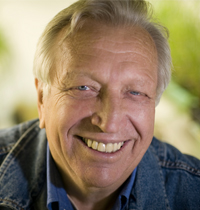
Wes Jackson is one of the foremost figures in the international sustainable agriculture movement. Founder and president of The Land Institute in Salina, Kansas, he has pioneered reserach in Natural Systems Agriculture — including perennial grains, perennial polycultures, and intercropping — for over 30 years. He was a professor of biology at Kansas Wesleyan and later established the Environmental Studies program at California State University, Sacramento, where he became a tenured full professor. He is the author of several books including Becoming Native to This Place (1994), Altars of Unhewn Stone (1987), and New Roots for Agriculture (1980).
The work of the Land Institute has been featured extensively in the popular media, including The Atlantic Monthly, Audubon, The MacNeil-Lehrer News Hour, and All Things Considered. Life magazine predicted Wes Jackson will be among the 100 "most important Americans of the 20th century." He is a recipient of the Pew Conservation Scholars award and a MacArthur Fellowship, and has been listed as one of Smithsonian's "35 Who Made a Difference". Wes has an M.A. in botany from University of Kansas, and a Ph.D. in genetics from North Carolina State University.
One in a series of oral history interviews created by AFSIC to capture the leaders in sustainable agriculture from the decades preceding the 1990s. Interview recorded in 1990.
Wes Jackson, Ph.D., as the co-founder with Dana Jackson of the Land Institute, has researched and influenced thought on the environment and agriculture in general and specifically perennial polyculture cropping systems based on the prairie ecosystem. He is a farmer, philosopher and author of several landmark books on the subject of sustainable agriculture.
The segments in the Questions section are drawn from the full interview. They duplicate video segments from the menu. These are not verbatim questions asked by the interviewer, but rather topics addressed by Dr. Jackson during the course of his interview. We hope that this will be an informative and interesting way to view the conversation.
Part 1 (Intro), Part, 3, Part 4, Part 5, Part 6, Part 7, Part 8, Part 9, Part 10, Part, 11, Part 12
Forever Planting (for Peak Oil & Climate Change)
We depend utterly on fossil fuels, especially to grow our food. From natural gas comes the millions of tons of fertilizers. Oil provides herbicides and pesticides. All is planted and harvested with oil power, driven, shipped or flown to your table.
For now. Until fossil fuels become too expensive, too rare, too polluting to use. We only have a short time to find other ways.
Wes Jackson offers some answers, for our food supply during peak oil and climate change. Raised on a Kansas farm, Jackson is a biologist, a geneticist, and botanist. In 1976 he left university life to found "The Land Institute", which he still heads. He's going to explain "natural systems agriculture", in a powerful speech given to the Association for the Study of Peak Oil USA. Recorded in Washington D.C. November 4th, 2011 by Gerri Williams for Radio Ecoshock (available nowhere else).
Then we'll hear a different assessment of the potential for sequestering carbon in the soil, and biochar, from the Australian carbon cycle expert Dr. Michael Raupach.
This Radio Ecoshock program is part of our "Big Picture" solutions series.