
Our books, reports, podcasts, and online course are ideal for use in college and high school classrooms. Produced by subject matter experts for non-specialists, they make complex issues understandable to lay audiences without losing rigor and depth. Best of all, being a non-profit organization allows us to keep our publications affordable (or free) and easily accessible for students
We work with various partners to produce and distribute our books. For academic orders and desk copy requests of books, click on the links below for title-specific information. For further information or questions, contact Publications Director Daniel Lerch.
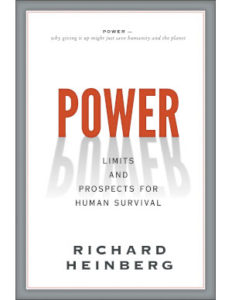 Power: Limits and Prospects for Human Survival
By Richard Heinberg, 2021
How has Homo sapiens—one species among millions—become powerful enough to threaten a mass extinction and disrupt the Earth’s climate? Why have we developed so many ways of oppressing one another? Can we change our relationship with power to avert ecological catastrophe, reduce social inequality, and stave off collapse? These questions—and their answers—will determine our fate.
Read the Introduction![[Think Resilience logo]](https://www.postcarbon.org/wp-content/uploads/2020/08/logo_think-resilience-2020_300x54.png) Think Resilience self-directed online course
Think Resilience self-directed online course
Hosted by Richard Heinberg
We live in a time of tremendous political, environmental, and economic upheaval. What can we do? Think Resilience is an online course to help you start doing something about climate change and our other sustainability challenges—starting in your own community. It consists of twenty-two short videos (about four hours in total) that explore the interrelated crises of the twenty-first century, and what we as citizens, students, and community leaders can do to respond to them. FREE ONLINE.
Take the Course Crazy Town podcast
With equal parts humor and in-depth analysis, Asher, Rob, and Jason safeguard their sanity while probing crazy-making topics like climate change, overshoot, runaway capitalism, and why we’re all deluding ourselves.
Listen Now What Could Possibly Go Right? podcast
Climate change, economic injustice, systemic racism…it seems like so much is going wrong right now. In this podcast, author, activist, and host Vicki Robin asks cultural scouts a single question: what could possibly go right? Our guests’ insightful answers and the short, deep-dive conversations that ensue, can help all of us see more clearly, act more courageously, and better serve the common good.
Listen Now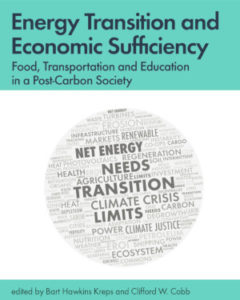 Energy Transition and Economic Sufficiency: Food, Transportation and Education in a Post-Carbon Society
Edited by Bart Hawkins Kreps and Clifford W. Cobb, 2021
Renewable energy sources have powered civilizations for nearly all of history and must do so again. But usable energy will become a more precious resource, as it was before our brief, explosive binge on the most easily accessible fossil fuels. In coming years we will have to recognize when “enough is enough.” Sufficiency, not growth, needs to be the focus of the new economy.
Read the Introduction
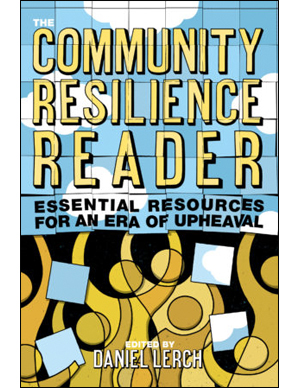 The Community Resilience Reader: Essential Resources for an Era of Upheaval
Edited by Daniel Lerch, 2017
National and global efforts have failed to stop climate change, transition from fossil fuels, and reduce inequality. We must now confront these and other increasingly complex problems by building resilience at the community level. The Community Resilience Reader combines a fresh look at the challenges humanity faces in the 21st century, the essential tools of resilience science, and the wisdom of activists, scholars, and analysts working with community issues on the ground. FREE ONLINE.
Read Now
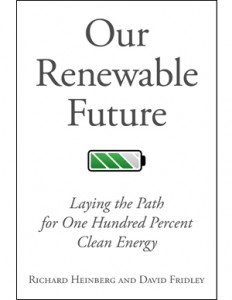 Our Renewable Future: Laying the Path for One Hundred Percent Clean Energy
By Richard Heinberg David Fridley, 2016
Over the next few decades, we will see a profound energy transformation as society shifts from fossil fuels to renewable resources like solar, wind, and biomass. The transformation will entail a major shift in how we live. What might a 100% renewable future look like? What challenges will we face in this transition? And how can we make sure our new system is just and equitable? FREE ONLINE.
Read Now
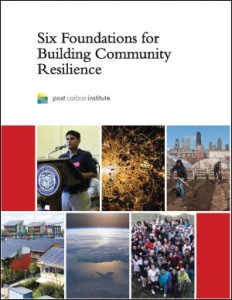 Six Foundations for Building Community Resilience
By Daniel Lerch, 2015
Climate change is not the only crisis we face, nor is preparing for disruption the only way to build resilience. Truly robust community resilience should do more. It should engage and benefit all community members, and consider all the challenges the community faces—from rising sea levels to a lack of living wage jobs. FREE ONLINE.
Read Now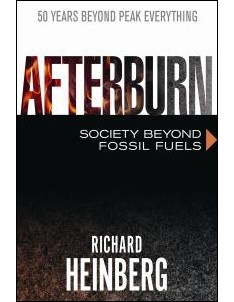 Afterburn: Society Beyond Fossil Fuels
By Richard Heinberg, 2015
Climate change, along with the depletion of oil, coal, and gas, dictate that we will inevitably move away from our profound societal reliance on fossil fuels; but just how big a transformation will this be? While many policy-makers assume that renewable energy sources will provide an easy “plug-and-play” solution, author Richard Heinberg suggests instead that we are in for a wild ride: a “civilization reboot” on a scale similar to the agricultural and industrial revolutions… more
Buy Now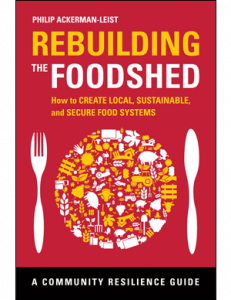 Rebuilding the Foodshed: How to Create Local, Sustainable, and Secure Food Systems
By Philip Ackerman-Leist, 2013
Foreword by Deborah Madison
Showcasing some of the most promising, replicable models for growing, processing, and distributing sustainably grown food, Rebuilding the Foodshed points readers toward the next stages of the food revolution. It also covers the full landscape of the burgeoning local-food movement, from rural to suburban to urban, and from backyard gardens to large-scale food enterprises… more
Buy Now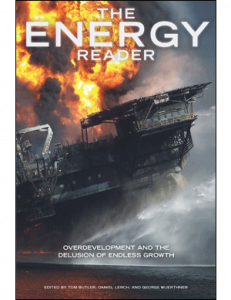 The ENERGY Reader
Edited by Tom Butler, Daniel Lerch, & George Wuerthner, 2012
From oil spills, nuclear accidents, mountaintop removal coal mining, and natural gas “fracking” to large-scale wind, solar, and biomass plants, every source of energy has costs. The ENERGY Reader takes an unflinching look at the systems that support our insatiable thirst for more power along with their unintended side effects. Over thirty leading thinkers on energy, society, and ecology lift the veil on the harsh realities of our pursuit of energy at any price, revealing the true costs, benefits, and limitations of all our energy options. FREE ONLINE.
Read Now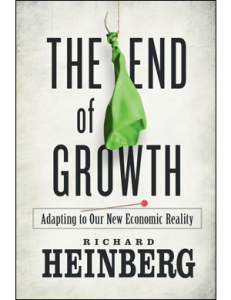 The End of Growth: Adapting to Our New Economic Reality
By Richard Heinberg, 2011
The End of Growth explores how the expansionary trajectory of industrial civilization is colliding with non-negotiable natural limits. Richard Heinberg goes to the heart of the ongoing financial crisis, explaining how and why it occurred, and what we must do to avert the worst potential outcomes. Written in an engaging, highly readable style, it shows why growth is being blocked by three factors: resource depletion, environmental impacts, and crushing levels of debt… more
Buy Now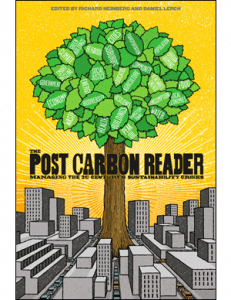 The Post Carbon Reader: Managing the 21st Century’s Sustainability Crises
Edited by Richard Heinberg and Daniel Lerch, 2010
How do population, water, energy, food, and climate issues impact one another? What can we do to address one problem without making the others worse? The Post Carbon Reader features essays by some of the world’s most provocative thinkers on the key issues shaping our new century, from renewable energy and urban agriculture to social justice and community resilience. FREE ONLINE.
Read Now