
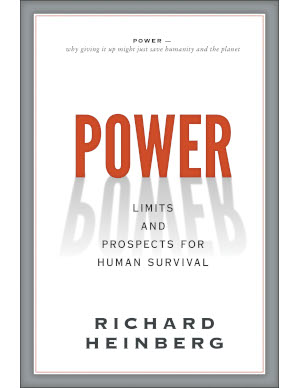
Power: Limits and Prospects for Human Survival
September 15, 2021
Featured in Bloomberg Best Books of 2021.
Power: Limits and Prospects for Human Survival traces how humans have come to overpower the earth’s natural systems and oppress one another…with catastrophic implications.
Humanity must act quickly to prevent environmental and economic collapse. But is it even possible for human beings to deliberately rein in our power? Power lays the groundwork to understand what we’ve done and how to fix it.
Power: Limits and Prospects for Human Survival by Richard Heinberg. Published 2021 by New Society Publishers. Paperback. 416 pages. ISBN 9780865719675. Also available as an eBook and audiobook.
Buy the book
- Bookshop.org (US): paperback, ebook, audio
- New Society Publishers (Canada): paperback, ebook, audio
- Waterstones (United Kingdom): paperback
- Booktopia (Australia); paperback, ebook
- Amazon Audible
- Barnes & Noble Nook
Academic copies
Resources
- Power Book Reading Guide. This 20-page reading guide provides a summary, key takeaways, and discussion questions for each chapter.
- Chapter commentary videos. Richard originally recorded these chapter commentaries in Summer 2021 exclusively for pre-order customers; they are now available to all.
- Discussion webinar videos, 2021. Richard led these three book discussion webinars in Summer 2021 exclusively for pre-order customers; they are now available to all.
- Power Podcast (2022, 9 episodes). This podcast is based on the book; hosted by Melody Travers (Absolute AI podcast) and Rob Dietz (Crazy Town podcast).
About Power
“In this book Richard Heinberg offers a powerful new way of understanding the historic rise and probable fall of our species. It is an impressive, sweeping, and thought-provoking narrative.”
—Dennis Meadows, coauthor, The Limits to Growth
“Richard Heinberg is a writer of unfailing interest and this book sums up much of his life’s thinking. Understanding our dilemma in terms of power is, well, a powerful way for getting at the predicaments and possibilities of this fraught moment in our evolving history as a species.”
—Bill McKibben, author of Falter and co-founder of 350.org
“Richard Heinberg’s panoramic review of known forms of power is both sobering and inspiring. Given our species’ habitual methods for getting its way, be these methods physical, mental, or social, the outlook for our future is bleak indeed. Yet, Heinberg allows for the slim but real possibility of exercising restraint. If we are so persuaded, by wisdom or love for beauty, the future even now remains open. Indeed, such restraint returns us to ancient, almost forgotten appetites and capacities.”
—Joanna Macy, author, World As Lover, World As Self
“A profound, rigorous, convincing, and actionable lesson on how to understand power less as the control one has over others than as the collective capacity we have to share with one another. A rich, moving, and necessary treatise from our most accomplished, coherent, and compassionate thinker on sustainable futures. This can still be accomplished.”
—Douglas Rushkoff, author, Team Human
“Heinberg goes to the very heart of the issue. Using his immense knowledge of biology, science, history, psychology. and the politics of energy, he shows that the environmental and social crises we face today have in their origin the insatiable human pursuit (and often abuse) of power, in all its forms.
“In showing us the path forward, Heinberg guides us to achieve power-limiting behavior so that we can not only survive but thrive on a healthy planet and in healthy balance with one another.”
—Maude Barlow, cofounder, The Blue Planet Project
“I’ve thoroughly enjoyed reading Power. It brings a half century if scholarship and thinking into clear focus.”
—David Orr, Paul Sears Distinguished Professor of Environmental Studies and Politics Emeritus, Oberlin College
“Power: Limits and Prospects for Human Survival is sweeping in scope and a powerful presentation. Richard Heinberg is willing to face the harsh reality of multiple, cascading social and ecological crises without flinching, and he has written a comprehensive book offering readers a framework moving forward that isn’t based on wishful thinking. Drawing on his decades of activism and research, Heinberg explains why power and energy are central concepts for understanding the human predicament and shaping our future.
“Equal parts science and philosophy, history and contemporary analysis, Power is more engaging than a scholarly tome and more thoughtful than journalism. Heinberg’s book is a model of public scholarship about life-or-death challenges to human societies.“
—Robert Jensen, Emeritus Professor, University of Texas at Austin
“Power is an extraordinary tour de force. It is a comprehensive compendium of how it has emerged, despite our self-proclamation to be sentient beings, that we now find ourselves scrambling on the edge of a cliff. Ironically this perilous rock-face is one that we ourselves have created. As a species, spurred on by the power of our migrant curiosity, we have exploited the immediate opportunities of the natural world while blindly discounting the future. But our planet keeps score — and fortunately so does Richard Heinberg.
“Power is a must-read. It is a call to action for those seeking a sustainable, balanced, human future in harmony with the Earth. No guarantees, of course, but harnessing the power of sentient action certainly beats the alternative: of continuing our blind stumble only soon to be swept aside, as have many creatures before us.”
—Peter Whybrow, author, The Well-Tuned Brain: Neuroscience and the Life Well-Lived
“Power is Heinberg’s masterwork. And it could not be more timely, arriving just as that window of time for action threatens to slam shut. Ignore this book at your peril.”
—Stan Cox, author, The Green New Deal and Beyond
“Power serves as a Rosetta Stone to decipher how our species went from one of many to apex predator in a very short time. A necessary book to fully understand the imperative that our species return to “right relation” in this critical time.”
—Peter Buffett, composer and philanthropist
“Heinberg’s Power is a searing, unflinching revelation of what has driven us to our current existential crisis: humanity’s quest for power. Impeccably researched and masterfully written, this book explains how and why humanity is driving itself off the cliff. If there is any hope for us to continue, Heinberg shows why it must come from efforts to limit our own power.”
—Dahr Jamail, author of The End of Ice: Bearing Witness and Finding Meaning in the Path of Climate Disruption
“Power is Richard Heinberg at his synthesizing best. In this sweeping volume, he deftly links raw energy – essential for anything to happen in the physical world – to the exercise of political power in the cultural domain.
“If the productive use of energy to expand is the ultimate key to evolutionary success, then humanity has no equal on Earth. But energy is also the ultimate source of material success, society’s addiction to economic growth and the international power politics that are destroying the planet. In Power , Richard Heinberg asks whether we can avoid catastrophe. Will competing nations’ primal lust for power give way to high intelligence, mutual trust, and unreserved cooperation in the quest to salvage civilization? Not a trivial question – failure would deny humanity the chance to advance another rung up the evolutionary ladder.”
—William E. Rees, FRSC, Professor Emeritus, University of British Columbia; co-originator of the ecological footprint concept
“Power reminds us that Richard Heinberg is one of the most important public intellectuals in the conversation about society’s future. Eminently readable and engaging, Power is breathtaking in its scope and insight. Heinberg persuasively argues that we have reached evolutionary limits to concentrated social power and that empathy and beauty are key to averting ecological and social catastrophe.”
—Chuck Collins, Institute for Policy Studies, author, The Wealth Hoarders: How Billionaires Pay Millions to Hide Trillions
“I turn to Richard Heinberg whenever I need to understand something about energy; he’s the ‘go-to’ source. And now this! Power, with seamless fluency in paleo-history, economics, psychology, and politics, is the ‘must-read’ for anyone wondering how we can make it through the 21st century. This book is more than informative. It is enlightening. It is essential. It is powerful!”
—Suzanne Moser, climate researcher and consultant
“A delight to read, it has a number of sobering messages for policy makers and politicians alike… Setting this book apart from virtually all others covering the topic of energy transition and climate change is that Heinberg covers power in all its manifestations… A sobering and timely book just as many governments appear to acknowledge – after decades of inaction – the dangers of climate change.”
—EEnergy Informer
“It may be a moral idea that hard work pays off but if we need proof that it counts, this latest of Richard Heinberg carries all the evidence we need. His encyclopedic treatment of power is brilliant. It is sure to pop up in courses and living rooms like toast.”
—Wes Jackson, Founder, The Land Institute
Journal of Ecohumanism book review, January 2022
“Power, I believe, has set the parameters for all future discussion of our ecological predicament…”
Bloomberg.com’s The Best Books of 2021, December 15, 2021
“We must profoundly change our ways and do it fast, according to Heinberg, or suffer the direst of consequences.”
World Literature Today book review, Autumn 2021
“Heinberg…make[s] a compelling case for how our misconception and misuse of power has led to the confluence of predicaments we must now face.”
Mud City Press book review, September 30, 2021
“A brilliant and searching probe into power in all its forms…”
Breaking Down: Collapse podcast interview, March 29, 2022
Accidental Gods podcast interview, December 29, 2021
`Radio EcoShock interview, December 8, 2021
Global Research News Hour interview, October 23, 2021
Growthbusters podcast interview, October 12, 2021
Sismique podcast interview, October 7, 2021
KQSD Community Radio interview, October 6, 2021
Jefferson Public Radio interview, September 29, 2021
Team Human podcast interview, September 15, 2021
Crazy Town podcast interview, June 16, 2021
What Could Possibly Go Right? podcast interview, June 8, 2021
Introduction
Chapter 1. Power in Nature: From Mitochondria to Emotion and Deception
- The Basis of Life’s Power
- Power and Bodies
- Power and Behaviors
- Proto-Human Powers
Chapter 2. Power in the Pleistocene: On Spears, Fires, Furs, Words, and Flutes—And Why Men Are Such Power-Hogs
- Hands and Stone
- The Fire Ape
- Skins
- From Grunts to Sentences
- Gender Power
- The Power of Art
Chapter 3. Power in the Holocene: The Rise of Social Inequality
- Gardening, Big Men, and Chiefs: Power from Food Production
- Plow and Plunder: Kings and the First States
- Herding Cattle, Flogging Slaves: Power from Domestication
- Stories of Our Ancestors: Religion and Power
- Tools for Wording: Communication Technologies
- Numbers on Money
- Pathologies of Power
Chapter 4. Power in the Anthropocene: The Wonderful World of Fossil Fuels
- It’s All Energy
- The Coal Train
- Oil, Cars, Airplanes, and the New Middle Class
- Oil-Age Wars and Weapons
- Electrifying!
- The Human Superorganism
Chapter 5. Overpowered: The Fine Mess We’ve Gotten Ourselves Into
- Climate Chaos and Its Remedies
- Disappearance of Wild Nature
- Resource Depletion
- Soaring Economic Inequality
- Pollution
- Overpopulation and Overconsumption
- Global Debt Bubble
- Weapons of Mass Destruction
Chapter 6. Optimum Power: Sustaining Our Power Over Time
- Involuntary Power Limits: Death, Extinction, Collapse
- Self-Limitation in Natural and Human-Engineered Systems
- Taboos, Souls, and Enlightenment
- Taxes, Regulations, Activism, and Rationing: Power Restraint in the Modern World Games, Disarmament, and Degrowth
- Denial, Optimism Bias, and Irrational Exuberance
Chapter 7. The Future of Power: Learning to Live Happily Within Limits
- All Against All
- Trade-Offs Along the Path of Self-Restraint
- The Fate of the Superorganism
- Questioning Technology
- Learning to Live with Less Energy and Stuff
- Lessening Inequality
- Population: Lowering it and Keeping It Steady
- Fighting Power with Power
- Long-Term Power through Beauty, Spirituality, and Happiness
Introduction
1. Defining Power
Chapter 1
2. Powers in Math
3. Measures of Physical Power
4. How Much Power?
Chapter 2
5. Ominous Power from Space: Asteroids, Comets, and Climate Change
6. A Watery Theory of Human Origins
7. Male Violence
8. Human Aesthetic Decadence
Chapter 3
9. Measures of Social Power
10. Pandemics and the Evolution of States and Empires
11. Slavery and Power
12. DNA Evidence for Steppe Invasions
13. Justifying Colonialism
14. The Original Sins of Mainstream Economists
15. Institutional Power
16. Genocide as Ultimate Exclusionary Social Power
17. Key Writers on Power
Chapter 4
18. An Arrested Industrial Revolution in China
19. Geopolitics: Global Power
Chapter 5
20. Personal Carbon Output
21. Rising Risk of Disease and Pandemic
22. Inequality in Economic and Political Power in the US, and Its Consequences
23. Guns: The Power to Kill Cheaply and Easily at a Distance
Chapter 6
24. The 2,000-Watt Society
Chapter 7
25. Viktor Frankl and the Will to Meaning
26. Dethroning GDP: Key to Limiting the Power of the Superorganism
27. Energy and Human Values
28. Advice to Young People in the 21st Century
29. Power Analysis and Organizing for Activists
1.1 Proton pumping in a bacterium
1.2 Exponential growth
1.3 The energy pyramid in nature
1.4 Visualization of Kleiber’s law
2.1 Global temperatures during the Pleistocene and Holocene
2.2 Key language, motor, and auditory areas of the brain
3.1 Placement of people on a slave ship
5.1 Global wildlife decline
5.2 Global extraction/production of resources in 1875, 1945, and 2015 (metric tons)
5.3 Power Center import vulnerability ratings of nonrenewable resources
5.4 United States top one percent income share (pre-tax)
5.5 Growth in total global debt by sector, 1999-2019
5.6 Gun ownership and violent deaths
6.1 Predator/prey dynamics
6.2 The adaptive cycle