
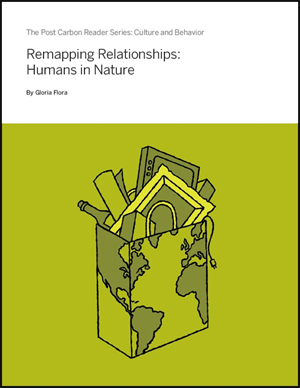
Report


EXCERPT:

It seems that the more a society sees itself as cerebral, with clever technological and material innovations, the more its bonds with, and recognition of, the significance of nature processes and ecosystems recede.  The ability to create artificial environments (air conditioning, heating, lighting) and chemically alter natural materials (processed food, plastic) perhaps gives the illusion that humans are capable of meeting their needs with minimal imputs from nature.  The flawed logic suggests that if humans are only tangentially dependent on the natural world, functioning ecosystems lose importance.

This chasm between humas and nature has widened to the point, especially in developed contries, where ubiquitous pollution and extirpation of species are commonplace-accepted by the masses as a nominal required consequence of economic growth.


Read the full report:
»  Download the PDF (1.95 MB)
»  View on Scribd

From the Post Carbon Institute/Watershed Media Book:

Post  Carbon  Reader cover

The Post Carbon Reader

Managing the 21st Century’s Sustainability Crises

Edited by Richard Heinberg and Daniel Lerch

Overview
Table of Contents
Content available for download
Order the book

about The Post Carbon Reader

How do population, water, energy, food, and climate issues impact one another? What can we do to address one problem without making the others worse? The Post Carbon Reader features essays by some of the world’s most provocative thinkers on the key issues shaping our new century, from renewable energy and urban agriculture to social justice and community resilience. This insightful collection takes a hard-nosed look at the interconnected threats of our global sustainability quandary and presents some of the most promising responses.

Contributors to The Post Carbon Reader are some of the world's leading sustainability thinkers, including Bill McKibben, Richard Heinberg, Stephanie Mills, David Orr, Wes Jackson, Erika Allen, Gloria Flora, and dozens more.

Published by Watershed Media, October 2010
552 pages, 6 x 9“, 4 b/w photographs, 26 line illustrations
$21.95 paper 978-0-9709500-6-2


Like this report?

Keep the information flowing: Donate to Post Carbon Institute
Stay connected: Receive our monthly e-newsletter
Reposting: See our reposting policy

blog comments powered by Disqus