
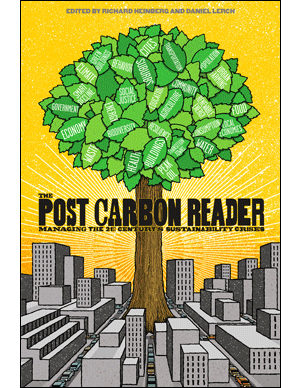
The Post Carbon Reader: Managing the 21st Century’s Sustainability Crises
Anthony Perl Asher Miller Bill Ryerson Bill Sheehan Brian Schwartz Chris Martenson Cindy Parker Daniel Lerch David Fridley David Hughes David Orr Erika Allen Gloria Flora Hillary Brown John Kaufmann Joshua Farley Michael Bomford Michael Shuman Peter Whybrow Richard Gilbert Richard Heinberg Rob Hopkins Sandra Postel Stephanie Mills Tom Whipple Warren Karlenzig Wes Jackson William Rees Zenobia Barlow
October 10, 2010
How do population, water, energy, food, and climate issues impact one another? What can we do to address one problem without making the others worse? The Post Carbon Reader features essays by some of the world’s most provocative thinkers on the key issues shaping our new century, from renewable energy and urban agriculture to social justice and community resilience.
This insightful, award-winning collection takes a hard-nosed look at the interconnected threats of our global sustainability quandary and presents some of the most promising responses. The Post Carbon Reader has proven to be a valuable resource for policymakers, college classrooms, and concerned citizens.
“The Post Carbon Reader is an invaluable primer, resource and textbook. This is what you need to know, period.”
—Lester Brown, Earth Policy Institute
Published by Watershed Media in collaboration with Post Carbon Institute. Distributed by Publishers Group West. Fall 2010. 544 pages. ISBN 978-0-9709500-6-2.
Chapters
Visit the individual chapters below for links to read online.
- Beyond the Limits to Growth, Richard Heinberg
- What Is Sustainability?, Richard Heinberg
- Thinking ‘Resilience’, William E. Rees
- A New World, Bill McKibben
- The International Response to Climate Change, Richard Douthwaite
- The Upshot: What Is to Be Done?, David Orr
- Water: Adapting to a New Normal, Sandra Postel
- Peak Nature?, Stephanie Mills
- Getting Fossil Fuels Off the Plate, Michael Bomford
- Tackling the Oldest Environmental Problem: Agriculture and Its Impact on Soil, Wes Jackson
- Growing Community Food Systems, Erika Allen
- Population: The Multiplier of Everything Else, William N. Ryerson
- Dangerously Addictive: Why We Are Biologically Ill-Suited to the Riches of Modern America, Peter C. Whybrow
- Remapping Relationships: Humans in Nature, Gloria Flora
- The Human Nature of Unsustainability, William E. Rees
- Making Sense of Peak Oil and Energy Uncertainty, Daniel Lerch
- Hydrocarbons in North America, J. David Hughes
- Nine Challenges of Alternative Energy, David Fridley
- Peak Oil and the Great Recession, Tom Whipple
- Ecological Economics, Joshua Farley
- Money and Energy, Richard Douthwaite
- The Competitiveness of Local Living Economies, Michael H. Shuman
- The Death of Sprawl: Designing Urban Resilience for the Twenty-First-Century Resource and Climate Crises, Warren Karlenzig
- Smart Decline in Post-Carbon Cities: The Buffalo Commons Meets Buffalo, New York, Deborah E. Popper and Frank J. Popper
- Toward Zero-Carbon Buildings, Hillary Brown
- Local Government in a Time of Peak Oil and Climate Change, John Kaufmann
- Transportation in the Post-Carbon World, Richard Gilbert and Anthony Perl
- Climate Change, Peak Oil, and the End of Waste, Bill Sheehan and Helen Spiegelman
- Human Health and Well-Being in an Era of Energy Scarcity and Climate Change, Cindy L. Parker and Brian S. Schwartz
- Smart by Nature: Schooling for Sustainability, Michael K. Stone and Zenobia Barlow
- Community Colleges: A Vital Resource for Education in the Post-Carbon Era, Nancy Lee Wood
- Personal Preparation, Chris Martenson
- What Can Communities Do?, Rob Hopkins
- What Now? The Path Forward Begins with One Step, Asher Miller
Praise for The Post Carbon Reader

“This is one of the best readers that I have seen in my 48 years as a university professor. The articles were well-written, up to date, and contained some extremely valuable information. I suggested to the students that they keep the book for future reference, instead of selling it back to the bookstore at the end of the semester.”
— Al Williams, Professor Emeritus, Department of Sociology, University of Nebraska
“We used The Post Carbon Reader every which way in several classes, sometimes just individual chapters as needed. The students cited chapters very frequently in their term papers which indicates that it is pitched at the right level for them. I would rank it among the three most effective sources that we have ever used.”
— Bruce Milne, Director, Sustainability Studies Program, University of New Mexico
“I was looking for a text to serve as the basis for my first year seminar on sustainability. The Post Carbon Reader proved to be an outstanding option. The 27 students in the course found the articles extremely informative and very useful in catalyzing high levels of intellectual discourse about sustainability issues and topics. They have unanimously praised it as excellent. The fact that almost all of the chapters are available for download was critical because not only did it save the students some money since they did not have to purchase a text (although several of them opted to buy the book because it is so reasonably priced and they wanted a hard copy to begin their personal library of books related to sustainability), but it also supports the idea of sustainability because it illustrates how resources may be conserved while still achieving a desired objective. Kudos to the Post Carbon Institute.”
— Nicholas J. Smith-Sebasto, Executive Director, Kean University Center for Sustainability Studies
“The Post Carbon Reader is one of the most useful books out there.”
— Margaret Robertson, author of Sustainability: Principles and Practice
“We were searching for a text that took a step beyond Al Gore’s Our Choice when we came across The Post Carbon Reader. We try to take a holistic, systems-based approach in this class, so we explore many topics over the course of the semester—and the Reader addresses all of these and more.”
— Dan Handeen, Center for Sustainable Building Research, University of Minnesota
“I use various portions of The Post Carbon Reader in all my classes, and I reference it in my public presentations. I also note to all my undergrads doing senior projects, and graduate and doctoral students, that they need to read The Post Carbon Reader.”
— Bob Scarfo, Associate Professor, Washington State University, Spokane
“I used quite a few chapters from The Post Carbon Reader. I very much appreciate its forward-thinking orientation as students in Environmental Studies classes too often get overwhelmed with all the facts about how we’ve messed up the environment. The Reader allows students to see that there are visionary thinkers trying not only to construct blueprints of what a post-carbon society might look like, but also the roadmaps for how to get there. I’ll definitely use it again.”
— Stephen Zavestoski, Associate Professor, Sociology and Environmental Studies, University of San Francisco
“A terrific collection of essays. Definitely on my ‘highly recommended’ book list.”
— Karen Litfin, Department of Political Science, University of Washington, Seattle
“I’ve used the book with students, as it’s simply the best single-volume reader that offers both background and cutting-edge thinking about issues that are crucial to the future of civilization.”
— Eric Zencey, Visiting Associate Professor of Historical and Political Studies at SUNY Empire State College
“I really like this text and I will use it again. It provides a great overview of environmental issues, and is very accessible for the students.”
— Tatiana Abatemarco, Assistant Professor of Environmental Studies, Paul Smith’s College
“The entire book is fantastic and extremely useful!”
— Stephanie Kennedy, graduate student in the School of Natural Resources at the University of Nebraska-Lincoln
“I have been using a few chapters and finding they are succinct and terrific!”
— Jeffrey Broadbent, Associate Professor, Sociology, University of Minnesota
“The editors’ objectives of inclusiveness, interconnectedness, and individual action distinguish this book from others. Framing sustainability as a form of resilience, The Post Carbon Reader offers a positive message on adaptation and transformation, rather than merely explaining the direness of the current global situation.”
— Jennifer Sklarew, book review in The Journal of Planning Education and Research, September 2012 vol. 32 no. 3 370-372
Updates and Errata
Please be aware of the following updates and errata in The Post Carbon Reader:
- Page 34, image caption should read, “…degree of connectedness…”; this has been corrected as of the third printing.
- Page 324, first line in the body text should read “…fossil-fuel use…”; this has been corrected as of the second printing.
- Page 480, the Web page referenced in endnote 10 is no longer available; a cached version can be found here and various mirror copies are available here.